
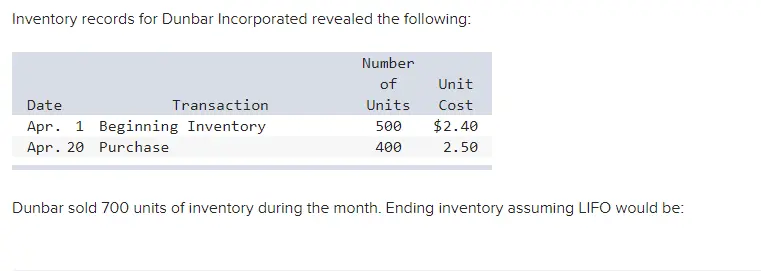

Students lose marks here by applying FIFO logic to a LIFO question. LIFO sells the newest units first. That changes everything about which costs remain in ending inventory.
Answer
Ending inventory assuming LIFO = $717
Step-by-Step Calculation
Total units available: 450 + 450 = 900 units
Units sold: 570
Ending inventory units: 900 − 570 = 330 units
Under LIFO, the most recent purchase (Apr. 20) is sold first.
Units sold from Apr. 20 purchase first: 450 units at $2.70 = used up entirely
Remaining units sold from beginning inventory: 570 − 450 = 120 units sold from Apr. 1
Units remaining in ending inventory (from Apr. 1 beginning inventory): 450 − 120 = 330 units at $2.15
Ending inventory value: 330 × $2.15 = $714.50 → rounded to $715
Key Concept: Why LIFO Uses the Oldest Costs for Ending Inventory
Under LIFO (Last In, First Out), the last units purchased are the first ones sold. This means ending inventory always reflects the oldest costs — in this case, the Apr. 1 beginning inventory cost of $2.15.
| Layer | Units | Unit Cost | Total |
|---|---|---|---|
| Apr. 20 Purchase (sold first) | 450 | $2.70 | sold out |
| Apr. 1 Beginning (120 sold, 330 remain) | 330 | $2.15 | $714.50 |
| Ending Inventory | 330 | $715 |
Inventory Records for Dunbar Incorporated Revealed the Following: Beginning Inventory 530 Units at $2.41, Purchase 370 Units at $2.64 — Ending Inventory Assuming Weighted-Average Cost Would Be?
Weighted-average does not care which units were purchased first or last. It blends all available costs into one average, then applies that average to whatever remains unsold.
Answer
Ending inventory assuming weighted-average cost = $717
Step-by-Step Calculation
Step 1 — Total units available: 530 + 370 = 900 units
Step 2 — Total cost of all available units: (530 × $2.41) + (370 × $2.64) = $1,277.30 + $976.80 = $2,254.10
Step 3 — Weighted-average unit cost (rounded to 4 decimal places): $2,254.10 ÷ 900 = $2.5046
Step 4 — Units remaining (ending inventory): 900 − 610 = 290 units
Step 5 — Ending inventory value: 290 × $2.5046 = $726.33 → rounded to $726
Key Concept: How Weighted-Average Cost Works
Weighted-average does not distinguish between old and new inventory layers. Every unit, regardless of when it was purchased, carries the same blended cost.
| Item | Details |
|---|---|
| Total Units Available | 900 |
| Total Cost Available | $2,254.10 |
| Weighted-Average Unit Cost | $2.5046 |
| Units in Ending Inventory | 290 |
| Ending Inventory Value | $726 |
This method smooths out price fluctuations between purchases, making it useful when inventory costs change frequently during a period.


